Your loyal, hard-working farm dogs never complain. But the impact of their demanding, active lifestyle means that they can develop health issues.
A study of rural veterinary practice over a 12-period was undertaken to establish the main health issues in working farm dogs in NZ. Huntaways were over-represented in cases that included constipation, GDV (or “torsion”) and hip dysplasia. Heading Dogs over-represented in cases of multiple ligamentous injury of the stifle, disruption of the gastrocnemius or Achilles tendon, tarsal injuries and hip luxation.[1]
The same study found that euthanasia occurred following 10% of veterinary visits. The most important non-traumatic causes were due to GDV, degenerative joint disease, mammary neoplasia and diseases involving the female reproductive tract, cardiac disease and poisoning. The authors concluded that several of these important health issues may be amenable to intervention through nutrition.[2]
Here we explore the serious health conditions of Bloat & Torsion that can impact working farm dogs and are acute life-threatening conditions in dogs.
Gastric Dilatation (GD) or “bloat” is a rapid accumulation of gas / fluid / food (or a combination of all three) in the stomach which results in increased intragastric pressure. The 1st stage of GDV.
GDV (Gastric Dilatation & Volvulus) or “torsion” or “twisted gut” occurs when the stomach dilates (bloats) as above, then twists on its axis (volvulus).
Both conditions dilate the stomach, which compresses major abdominal vessels, impairing blood flow back to the heart. This can lead to shock and potentially, death if left untreated.
One study recorded the meal type of 27 dogs presenting at NZ veterinarian clinics with GD or GDV. 26 (96%) of the dogs were reported to have eaten meat, bones or scavenged a carcass and one dog (4%) was reported to have scavenged dog biscuits. This emphasised that dogs fed a large volume of food in one meal have been shown to be at high risk of developing GDV.[5] . Feeding farm dogs twice daily may reduce the incidence of GD or GDV.
Feeding too much at once isn’t the only danger. Partially thawed meat may trigger GD or GDV – so thaw frozen meat completely. As it is common for farmers in New Zealand to feed meat that has been previously frozen and it is possible that the meat has not thawed completely at the time of feeding, which may have increased the risk of GD or GDV.
Another study analysed the gastric contents of 41 working farm dogs with GD or GDV. 26/27 dogs had a history of having eaten meat, bones or scavenged a carcass. The odds that a case of GD or GDV was a Huntaway, after adjusting for age and season, was 19 times higher than the odds a control was a Huntaway.
Weight and breed are more important than gender where risk for GDV is concerned: Large breed and deep chested dogs (like Huntaways), as well as underweight dogs are all at higher risk of developing GDV [6].
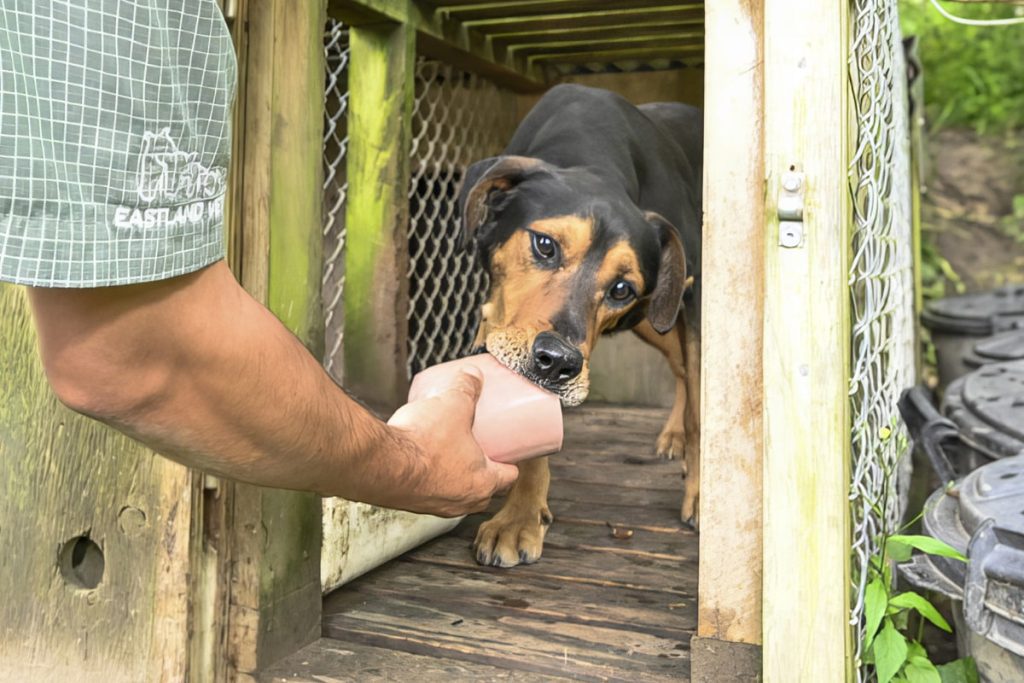
Keep your hard-working team safe – feed them completely thawed, smaller portions of nutrient-dense dog roll/blocks.
Quality, not quantity. Well thawed.
See why STAMINA dog food can help limit injuries and bloat/torsion in working dogs.
[1] Cave et al, 2009.
[2] Cave et al, 2009.
[5] Raghavenet al, 2006.
[6] Henricks et al, 2012.